
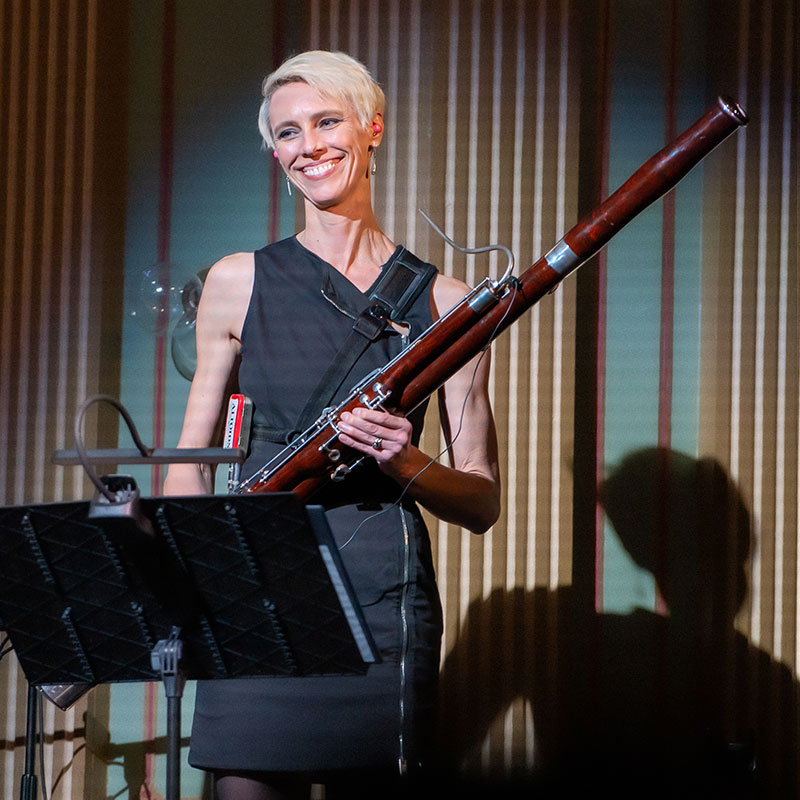
(Photo credit: Bill Hatzinger)
Picture a stereotypical classical musician. Then take that a step further and picture a stereotypical bassoon player. Got that in your mind?
Almost guaranteed, bassoonist Theresa Brooks looks nothing like what you pictured. With blonde hair cut short and sometimes spiked, irreverent t-shirts, black boots and an impish twinkle in her eye, she would easily blend in as part of an alt rock band.
Theresa is currently principal bassoonist in the Kankakee Valley Symphony Orchestra, and also plays with the Fox Valley Orchestra in Chicago’s west suburbs. She also plays in an ensemble for Tom Sharpe, the drummer for the prog rock band Mannheim Steamroller. And for 14 years prior to this, Theresa was manager and audio engineer at a recording studio in the west suburbs, and composed music for film and television.
In the summer of 2024, Theresa and I put our heads together on a collaboration with the unlikely goal of producing industrial music centered around the bassoon. We agreed this instrument is probably the most inherently classical - and therefore least industrial - instrument we could think of.
Challenge issued!
The product of that collaboration/experiment was the industrial single Breath in the Machine, released in March, 2025. Amidst her busy schedule of rehearsing and performing, Theresa was kind enough to sit down for the following interview.
What originally attracted you to the bassoon?
When I was in grade school my older sister took up the trombone. Of course I was dragged to her concerts and in the middle of the band was this black tube poking up above everyone’s heads. I thought, “That looks weird…I like weird. I want to play the bassoon!” And so a couple years later when it was my chance to choose an instrument I knew I wanted to play bassoon. I was already quite tall for my age (and continue to be quite tall for my gender, ha!) so at 11 years old my hands were already larger than my band director’s. Which deemed me fit for starting on bassoon directly, which isn’t often the case. Victory! For better or worse, I leaned into my weirdness! I continue to love the uniqueness of bassoon. In casual conversations I’m either met with people who exclaim their surprise and delight or I have a chance to describe what a bassoon is to someone who’s unfamiliar (it has a double reed like an oboe but is low in pitch like a cello, its tall and kinda looks like a giant bong).
And what do you most love about playing it?
What I enjoy about playing the bassoon is the challenge that comes with it. The left thumb alone has nine keys at its disposal. There are some passages where that thumb is flying all over the place and I liken it to playing a video game. But, more rewarding than Guitar Hero.
I also love the parts that are written for bassoon, both in traditional orchestral music and various genres of contemporary music. It’s a good balance of holding down the rhythm section or being a texture paired with other instruments. And then balanced with the moments where the bassoon gets the spotlight and we get to sing above the rest of the ensemble, playing either over-the-top somber or jovial. Both ends of the spectrum. But then we sink back into the texture.
Do you play any other instrument(s) and, if so, where or when?
I grew up with an old, out of tune (but beautiful looking) upright piano in my house. I mostly taught myself so my skill level only goes so far, but I certainly appreciated having the access to play around in my early years (and no doubt drove my family crazy playing the same thing over and over again).
When I was at the recording studio I learned to fake my way through very basic guitar, bass guitar and ukulele. And, of course, a basic mastery of “playing the studio” using synths and editing techniques.
Who are your favorite classical composers, and why?
I love the more modern composers, the romantics to the minimalists: Shostakovich, Rachmaninov, Saint-Saëns, Debussy, Ravel, Philip Glass, and Arvo Pärt. The romantics, especially the Russians, bring such over-the-top emotional stories to their music. It’s like metal and prog rock of that era. It’s such a journey to listen or perform a romantic symphony and while I’m in it, I am in it and on the edge of my seat. The anticipation that’s built for such extended lengths of time to finally resolve into another sea of anticipation, until finally a powerful ending that shows off the strength or peace that the protagonist gained through the journey (perhaps an influence on JRR Tolkein?).
And the minimalist composers, oh, what their music does to keep me grounded! I can be tied up in stress and anxiety and the instant I hear the simple tones that so beautifully interact with each other, my heart rate goes down, I breathe slower, and I can think and focus again. The music ties so well with the calm and peace that I strive for in my daily life, that my body requires. And just enough challenge in the interplay of notes and rhythms that it keeps the brain active and focused.
At the other end of the spectrum, who are your favorite post-punk or alternative bands, and how have they shaped your love of and approach to music?
In no particular order...David Bowie, The Pixies, Yo La Tengo, Bjork, Nina Simone, Joy Division, Velvet Underground, Buddy Holly and Martin Denny.
Brand new influences that are sure to stick in my canon are Nation of Language, Brigitte Calls Me Baby, and Still Corners.
What compositions or albums - classical, rock or any genre - made your jaw drop when you first heard them?
“Has Been” by William Shatner…believe it or not! Produced by Ben Folds and featuring a collection of guest musicians such as Henry Rollins and Joe Jackson. The selections are heart wrenching and performed with an intimate passion. My first time listening to the album I was doing renovations, hammer in hand kinda thing, and I had to switch out the disc, the album was too engrossing to multi-task.
“Post” by Bjork - A product of my formative teenage years, the pop and electronic sounds paired with the bombastic attitude of Bjork got me excited about what was possible when combining genres.
The song “Weak in Your Light” by Nation of Language was, and still is an absolute obsession of mine. Something about the synth tones, the wash of reverb, the progression…I’d say the first 100 times I heard it, I was put in a trance. (yes this implies I’ve listened to it more than 100 times since it was released two years ago.
The song “Mad Rush” by Philip Glass - As I was saying before about the minimal composers, the way that song specifically calms my nervous system… I was instantly addicted to it.
The song “Feeling Good” by Nina Simone - I wasn’t familiar with her until I stumbled on a YouTube video of her performing the song at the 1969 Harlem Cultural Festival which was later used in the documentary “Soul of Summer”. (For better or worse, the video of her performance has since been removed from YouTube, however the documentary is worth a watch). The whole package of her performance made me fall in love with her. Her smooth voice with impeccable air supply, the confidence she exuded, her passion to be in the moment of performance, the ability to sing and play piano at the same time, her honest vulnerability. She is just absolutely amazing.
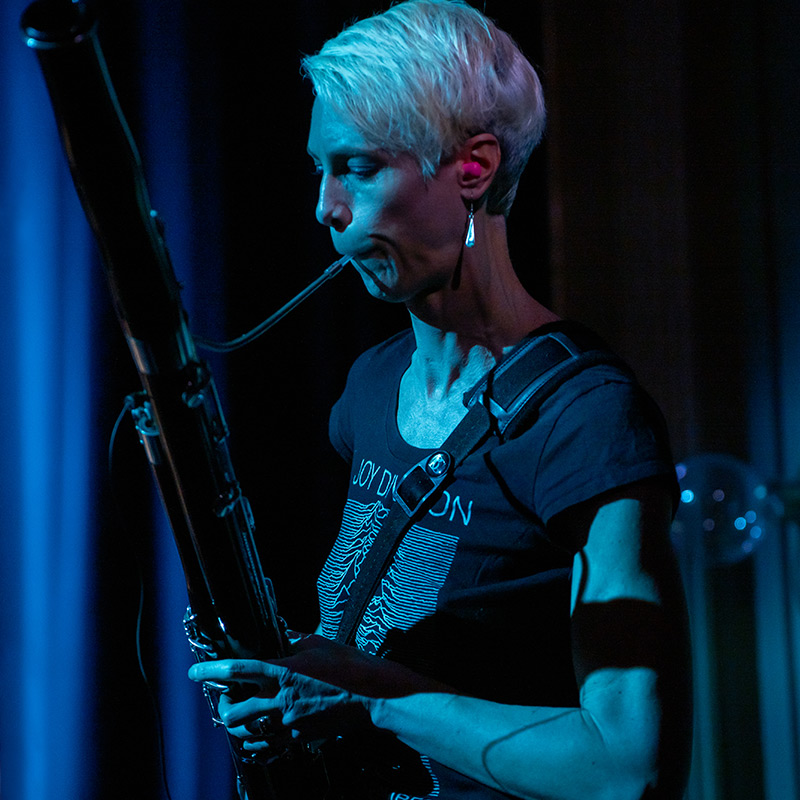
Theresa performing with Tom Sharpe in January 2025. (Photo credit: Bill Hatzinger)
What is the best live concert you’ve ever seen, and why?
The Chicago Sinfonietta performed the “1812 Overture” with Mucca Pazza at the Symphony Center in 2014. Again, I was excited by the merging of genres to give new life to such an iconic piece of music, plus the traditional orchestral hall hosting an adult punk rock marching band. What did me in was the song started very traditionally with just the orchestra on stage. At some point during the intro, additional low brass could be heard from an unknown location. And then, in the front middle of the stage, the additional horns could be spotted, slowly rising on the piano lift. From there, alongside impeccable musicianship, chaos ensued as the band literally ran all over the stage, the terrace, even the audience. Orchestral music can so often be stereotyped as stifling, so to bring it into a modern performance interpretation is delightful and memorable, especially as it plays into the ever increasing need of continuous endorphin hits in today’s society (phew, that gets us into an entirely new subject)!
Speaking for myself, Breath in the Machine was a really interesting experiment; I didn’t know what to expect but I’m so happy with how it all came out. What was your reaction when you first heard the composition?
My first reaction was, “this is cool, I like the sounds and how this builds, but…is there really bassoon in this?” Ha! I remember our recording session was really about experimentation and showing off what the bassoon could do. Which included all sorts of sounds, from bass grooves to squeals to literal noise and the kind of antics I’d do as a kid for a good laugh (like making the reed “fart”-- not sure if that one made it into the song).
So to hear the near final mix of the song that you shared to me before it was released was a little like exploring a new part of a familiar city at night. Feeling the awe and wonder of something new, having a little bit of my guard up, but the comfort to know that I still had the connection to home.
Musically, I think Breath in the Machine is hard to categorize. From your perspective, how would you explain or describe Breath in the Machine?
I certainly agree with you about Breath in the Machine being hard to categorize! I think I’d describe the song as a welcoming industrial soundscape. The industrial inspiration shows up with the sounds of machinery that are propelled by the ongoing bass groove. However, it veers from the industrial genre in a way that, to me, shows your influence from contemporary classical music that is less reliant on melody and features the exploration of tones, timbre and texture. So in this sense maybe I would classify it as a hybrid; let’s say an industrial contemporary classical soundtrack.
That said, you don’t have to be a listener of any of those genres to appreciate the song for what it is. As with most music that is uncategorizable, it draws people from outside their typical listening habits, as this song is something that can be listened to in pure, analytical attention or, as is done with a lot of video game music, the soundtrack to somebody’s day.
The music and recording industry has undergone something of a revolution over the last 20 years. If you could change anything about the current state of the industry, what would it be?
Corporate greed!
What further plans, goals or dreams do you have for yourself as a musician?
I certainly intend to continue playing with orchestras, or other small ensembles like Tom Sharpe’s. And I just like being open to interesting or unexpected opportunities or collaborations - it keeps life interesting!
Breath in the Machine is available on Bandcamp, Apple Music, Spotify and YouTube.
Learn more about the genesis of Breath in the Machine.
Written by Brian Tibbs